Nutrition tracking
Beyond Calories: Which Nutrition Numbers Are Worth Tracking?
Calories answer one question: energy. Protein, fat, carbohydrates, fiber, added sugar, and saturated fat add different context, but more numbers are useful only when you know what each can—and cannot—say.
Why track more than calories?
Calories answer one useful question: how much energy does a logged food or meal contain? They do not describe where that energy came from, whether a meal contains fiber, or how its fat and sugar are distributed. Two meals can have a similar calorie estimate and very different amounts of protein, fiber, added sugar, and saturated fat.
That is why a practical nutrition log can keep energy, macronutrients, and a few selected food-label signals in the same view. The aim is not to make every person monitor every available nutrient. It is to give each number a specific job and prevent one number from standing in for the whole diet.
The FDA defines calories as energy from carbohydrate, fat, protein, and alcohol in a serving. It also explains that the 2,000-calorie figure shown on U.S. labels is a general guide: an individual's needs may be higher or lower. See the official FDA explanation of calories on the Nutrition Facts label (opens in a new tab).
Which seven nutrition numbers are useful to track?
A useful number should answer a clear question. The seven fields below provide a compact view of energy, the three main macronutrients, and three selected signals that are easy to lose inside a calorie total. None of them, alone, can grade a meal or diagnose a nutrition problem.
| Number | Useful question it answers | What it does not establish |
|---|---|---|
| Calories | How much estimated energy came from the logged food or meal? | Overall food quality, exact energy absorbed, or your personal calorie requirement |
| Protein | How many estimated grams of protein were logged? | Protein source, amino-acid pattern, or whether the amount meets an individual need |
| Fat | How much estimated total fat was in the log? | The full mix of fat types; saturated fat needs its own field |
| Carbohydrates | How much estimated total carbohydrate was logged? | How much came from fiber, starch, or sugars, or how a specific person will respond |
| Fiber | How much estimated dietary fiber was present? | The variety of fiber-rich foods, the type of fiber, or complete diet quality |
| Added sugar | How much estimated sugar was added during processing or preparation? | Total sugar: naturally occurring sugar in fruit and milk is a different label concept |
| Saturated fat | How much of the estimated fat total was saturated fat? | The complete fatty-acid profile or the overall value of the food |
The categories mirror familiar parts of the U.S. Nutrition Facts label, which lists total fat, saturated fat, total carbohydrate, dietary fiber, total sugars, added sugars, and protein. Food Focus tracks added sugar rather than total sugar, so the two terms should not be treated as interchangeable. The FDA explains that total sugars include both naturally occurring and added sugars, while added sugars exclude sugars naturally present in milk, fruits, and vegetables. Read the FDA added-sugars guide (opens in a new tab).
How should you read nutrition numbers in context?
Start with the denominator: what amount of food does the number describe? Then decide whether you are reading a package label, an app estimate, or a target created for your profile. Those are related, but they are not the same thing.
- 1
Confirm the amount represented
Nutrition Facts usually describe one labeled serving. Your portion may be smaller or larger, and a serving size reflects what people typically consume—not a recommendation of how much you should eat.
- 2
Separate grams from percent Daily Value
Grams are amounts. Percent Daily Value (%DV) is label context showing how much one serving contributes to a general daily reference. It is useful for comparing packaged foods, but it is not a personalized prescription.
- 3
Match the number to the question
Use calories to review energy, protein/fat/carbohydrate to review macro distribution, and fiber/added sugar/saturated fat to inspect specific parts of the pattern. Do not ask one field to answer all three questions.
The FDA describes Daily Values as reference amounts and %DV as the contribution from one serving. Its general label-reading guide uses 5% DV or less as “low” and 20% DV or more as “high” for a nutrient in a serving. Those thresholds help interpret a label; they do not calculate what a particular person should consume. See the FDA Daily Value reference (opens in a new tab).
General guidance and individual needs should stay visibly separate. The current Dietary Guidelines for Americans, 2025–2030 (opens in a new tab) gives population-level guidance across the lifespan. It does not turn an app total or a Nutrition Facts Daily Value into a personal care plan.
Why are patterns more useful than one perfect day?
A single day can be unusual: travel, a celebration, illness, a restaurant meal, or one missing log can move the totals. A longer view can show whether a result repeats, while still reflecting only the meals you recorded. It should not create false certainty from incomplete data.
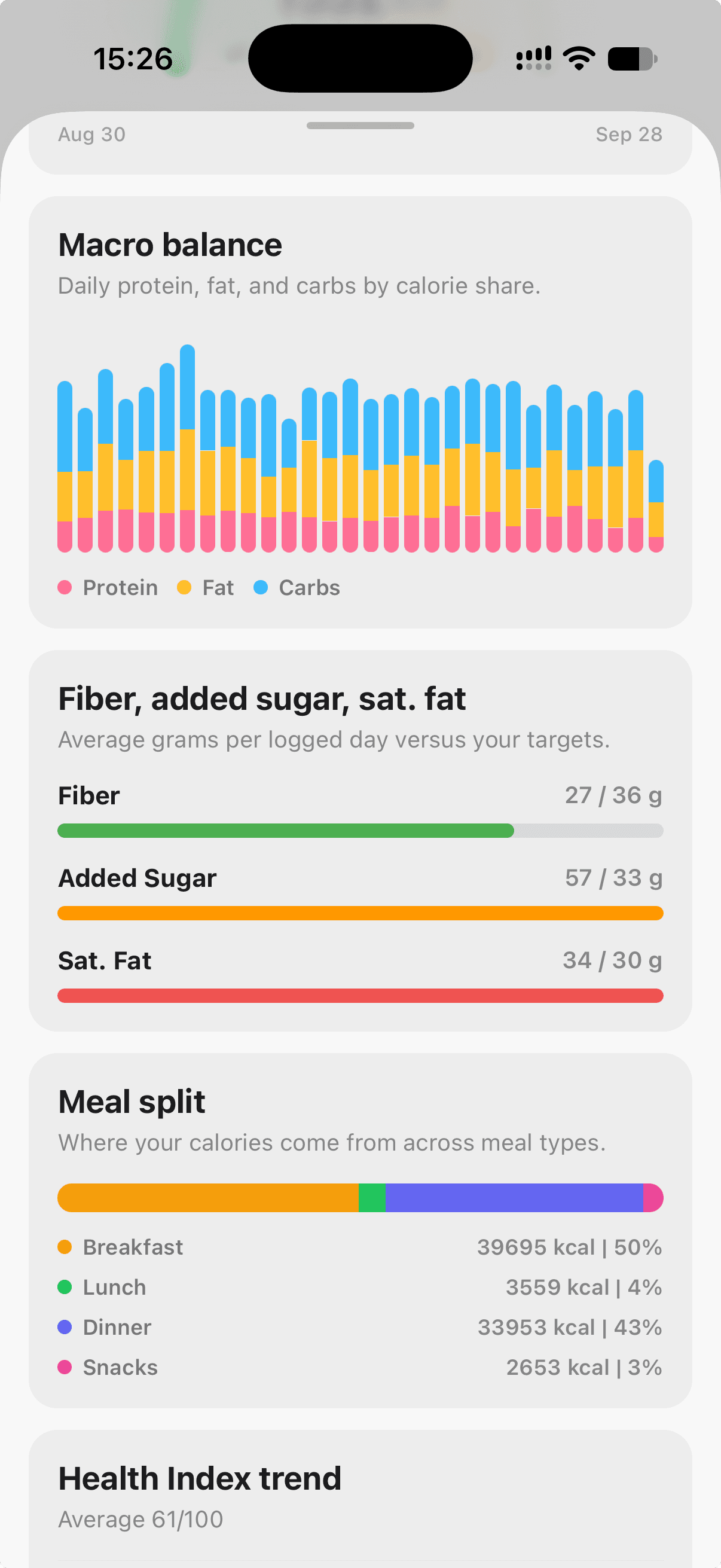
Macro balance shows the daily calorie share from protein, fat, and carbohydrates. Fiber, added sugar, and saturated fat compare average grams per logged day with targets. Meal split shows where the logged calories came from. Missing meals can move every chart, and the Health Index trend shown lower on this screen is a heuristic rather than a clinical score.
- Check completeness first. A low total may mean less was eaten, but it can also mean breakfast, a drink, cooking oil, or a snack was not logged.
- Correct large assumptions. Fixing a wrong portion or missing ingredient can matter more than inspecting a small rounding difference.
- Compare like with like. A seven-day view answers a different question from a ninety-day view. Use the same time window when checking whether a pattern changed.
- Look for repeatable questions. “Is fiber often low in the meals I actually logged?” is more useful than treating one low-fiber lunch as a diagnosis.
- Keep the foods visible. A numeric trend should lead back to the meals behind it, not replace them.
Calorie needs themselves vary with factors including age, body size, metabolism, sex, and physical activity. The National Institute of Diabetes and Digestive and Kidney Diseases explains that variation in its food-portion guidance (opens in a new tab). That is another reason not to copy a general calorie figure from a label or another person's app and treat it as your own requirement.
What does Food Focus track—and which signals are only inferences?
Food Focus saves calories, protein, fat, carbohydrates, fiber, added sugar, and saturated fat for logged meals. You can review foods and quantities before saving and edit an ingredient or portion when an estimate does not match what you ate. Photo, gallery, voice, and text values are estimates. Barcode values can combine product-database fields with AI estimates for missing tracked nutrients, so compare them with the current package and enter the gram amount accurately.
| Food Focus output | What it is | How to treat it |
|---|---|---|
| Seven saved nutrition fields | Numeric estimates for calories, protein, fat, carbohydrates, fiber, added sugar, and saturated fat | Review the foods and portions behind the values; correct material errors before relying on the log |
| Health Index | A directional heuristic generated for photo, gallery, voice, and text analyses; barcode entries currently start at zero instead | Use an AI-generated score as a simple signal, not a measurement, universal food grade, diagnosis, or laboratory result |
| Likely nutrient gaps | An AI inference from food names in the latest seven days after at least ten meals have been logged overall | Use it as a question to explore; it is not a complete micronutrient ledger, blood test, or confirmed deficiency |
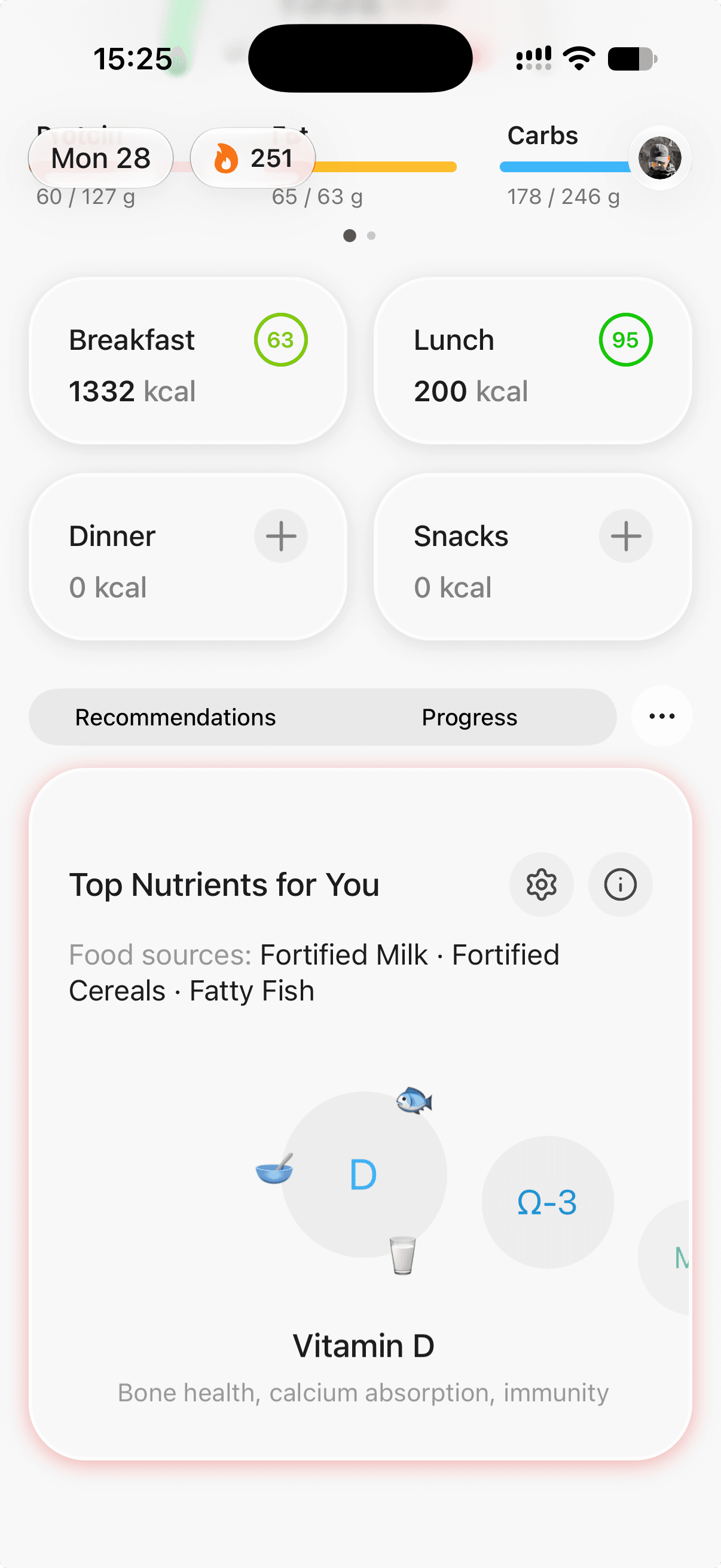
This example card names Vitamin D and possible food sources. It is an inference from recent logged food names, not a measurement of intake or a diagnosed deficiency. A clinician can interpret symptoms or laboratory results when that matters.
These distinctions matter when reading the chart: Food Focus does not claim that a photo measures nutrients, that its Health Index is clinically validated, or that a seven-day inference can diagnose a deficiency. The product's database sources, estimate workflow, and limitations are documented on the Food Focus sources and methodology page.
One current chart caveat matters: Food Focus can include a barcode entry's default Health Index of zero in its Health Index trend calculation. That zero is not an AI assessment, so a trend affected by barcode meals should not be interpreted as a change in meal quality.
For trend review, the Food Focus nutrition tracker offers 7-, 30-, and 90-day views. A longer chart does not repair missing meals or inaccurate portions; it simply organizes the saved data across a different window.
Track with context
See the seven numbers—then check the meal behind them.
The first 10 saved meals can use Cloud AI; after that, Cloud requires Pro. Eligible Apple devices can choose free on-device AI. Review estimates, correct portions, and explore whether daily and longer-term patterns are useful for you.
When do general numbers stop being enough?
General label context is useful for education and comparison. Individual nutrition decisions can depend on medical history, medications, symptoms, laboratory results, allergies, life stage, training demands, and the person's relationship with food. An app cannot safely resolve those factors from meal totals alone.
Ask a doctor or registered dietitian for individualized guidance if you are managing a health condition, have been given a therapeutic diet, need help interpreting symptoms or laboratory results, are concerned about growth or pregnancy-related needs, or find that tracking increases fear, guilt, restriction, or compulsive behavior around food. The U.S. Office of Disease Prevention and Health Promotion describes a registered dietitian as a health professional who helps people with healthy eating and recommends professional help when a person is worried about their eating habits. See its MyHealthfinder healthy-eating guidance (opens in a new tab).
Questions about which nutrition numbers to track
Which nutrition numbers should I track first?
Choose the smallest set connected to your goal. Calories provide energy context; protein, fat, and carbohydrates describe macronutrients; fiber, added sugar, and saturated fat add useful food-quality context. Medical conditions and therapeutic diets may require different fields chosen with a qualified professional.
Are calories or macros more important?
They answer different questions. Calories describe energy, while macronutrients describe where much of that energy and structural nutrition comes from. Neither single number summarizes overall diet quality, and the relevant emphasis depends on your needs.
Is total sugar the same as added sugar?
No. FDA defines total sugars as naturally occurring plus added sugars. Added sugars are introduced during processing or preparation and are shown as a subset of total sugars on U.S. Nutrition Facts labels.
Should I hit every target exactly each day?
Not necessarily. Intake and logging completeness vary from day to day. Trends across several days can be more useful than treating one daily total as a pass-or-fail score, unless a clinician has given you a specific daily requirement.
Can a nutrition tracker detect a deficiency?
No. A tracker can summarize logged foods or suggest that recent choices may undersupply a nutrient, but it cannot diagnose a deficiency. Diagnosis can require medical history, examination, and appropriate testing.
Sources and further reading
These sources support the general explanation above. They do not endorse Food Focus, and research methods do not automatically establish the accuracy of any specific consumer app.
- Calories on the Nutrition Facts Label (opens in a new tab)U.S. Food and Drug Administration
FDA guidance defining calories as energy and explaining why the 2,000-calorie label reference is a general guide rather than an individual requirement.
- The Nutrition Facts Label (opens in a new tab)U.S. Food and Drug Administration
The FDA's central guide to calories, serving size, nutrients, and other information on packaged-food labels.
- Daily Value on the Nutrition and Supplement Facts Labels (opens in a new tab)U.S. Food and Drug Administration
An explanation of what percent Daily Value means, which nutrients labels list, and how general reference values help compare foods.
- Added Sugars on the Nutrition Facts Label (opens in a new tab)U.S. Food and Drug Administration
FDA definitions of total and added sugars and guidance for interpreting grams and percent Daily Value.
- Dietary Guidelines for Americans, 2025–2030 (opens in a new tab)U.S. Department of Health and Human Services and U.S. Department of Agriculture
The current federal nutrition guidance for people across the lifespan and the basis for U.S. nutrition policy and programs.
- Food Portions: Choosing Just Enough for You (opens in a new tab)National Institute of Diabetes and Digestive and Kidney Diseases
NIH guidance explaining that calorie needs vary with factors such as age, size, metabolism, sex, and activity.
- Eat Healthy (opens in a new tab)MyHealthfinder / U.S. Office of Disease Prevention and Health Promotion
Official general healthy-eating guidance that explains the role of doctors and registered dietitians in individualized support.
- Food Focus nutrition sources, methodology and limitations (opens in a new tab)Food Focus
The exact Food Focus fields and the limits of its AI-estimated Health Index and possible nutrient-gap messages.