AI food logging
Can AI Calculate Calories From a Photo? What It Can—and Can’t See
A food photo can make logging faster, but it is still evidence for an estimate—not a direct measurement. Here is how the estimate works and what deserves a second look.
How does AI estimate calories from a food photo?
A camera does not read calories directly. A photo-based tracker builds an answer through several linked estimates. Research on image-based dietary assessment commonly separates the task into food detection, food classification, portion or volume estimation, and nutrient calculation. A mistake at any stage can change the final number.
- 1
Identify the visible foods
The system looks for likely ingredients or dishes: for example, rice, grilled chicken, broccoli, or a bowl of soup.
- 2
Estimate the portions
It infers how much of each food may be present from shape, area, depth cues, familiar objects, and the description supplied by the user.
- 3
Connect foods to nutrition data
Likely foods and amounts are mapped to nutrition records or model knowledge to estimate calories and nutrients.
- 4
Ask the person to review
The person who ate the meal can correct the food, portion, brand, recipe, or preparation details that the image could not establish.
A systematic review of image-based food-recognition systems describes this same multi-stage pipeline and the open challenges within it. The practical lesson is simple: a polished calorie total can still contain uncertainty inherited from several earlier assumptions. Read the systematic review in PubMed Central (opens in a new tab).
What can an AI food photo see—and what remains hidden?
Clear, separated foods give the model more visual evidence. But the image is still only a record of reflected light from one angle. It does not reveal an exact recipe, weight, or chemical analysis.
| A photo may help with | A photo usually cannot establish |
|---|---|
| Visible food categories and ingredients | Every ingredient inside a mixed dish |
| Approximate plate coverage and relative size | Exact grams, depth, density, or amount eaten |
| Obvious cooking form, such as whole, sliced, or fried | Oil absorbed during cooking or butter added earlier |
| Visible toppings, sides, and sauces | Hidden dressing, sugar, broth, filling, or marinade |
| Package appearance when branding is readable | The exact regional product or current label without verification |
A 2024 scoping review notes that portion estimation from a single image is difficult because ingredient amounts and cooking methods are not available from the image alone, while camera distance and angle change perceived size. That is why adding context can be more useful than asking the model to sound more certain. See the full review in the Journal of Medical Internet Research (opens in a new tab).
Why is portion size often the difficult part?
Recognizing “pasta” is different from knowing whether the bowl contains 180 grams or 320 grams. Both entries can use the same food record and still produce meaningfully different totals. A flat image compresses three-dimensional food into two dimensions, and foods have different densities: a cup of leafy greens, a cup of cooked rice, and a cup of nuts do not weigh the same.
The problem also exists outside AI. People estimating their own portions can over- or underestimate amounts. A review in the IEEE Journal of Biomedical and Health Informatics concludes that integrated systems combining different approaches may be more promising than relying on one visual method alone. Read the review abstract on PubMed (opens in a new tab).
Which meals are easier or harder to estimate from a photo?
“Easier” does not mean exact. It means the image contains more useful evidence and fewer hidden variables.
| Often easier to review | Often harder to review |
|---|---|
| Separated foods with clear boundaries | Soups, stews, curries, casseroles, and smoothies |
| Whole pieces such as one banana or two eggs | Stacked, folded, or partly hidden foods |
| A plate photographed clearly before eating | A close crop with no size reference or visible plate |
| Meals with a short, known ingredient list | Restaurant meals with unknown oil, sauce, and recipe quantities |
| Packaged food paired with its verified barcode or label | A product photographed without readable branding or serving information |
How can you improve a photo calorie estimate?
You do not need to turn every meal into a photography project. A few details can remove the largest ambiguities.
- Show the whole plate or container. Avoid cropping away sides, toppings, or the vessel that provides scale.
- Use clear light and a steady angle. Make separate foods and their boundaries easy to see.
- Name what the camera cannot know. Mention cooking oil, dressing, sweetener, filling, or a specific brand when it matters.
- Add an amount you already know. “Two eggs,” “one 150 g yogurt,” or “half the package” is better evidence than an image alone.
- Review before saving. Check the detected foods and portions; correct the highest-impact assumptions first.
The goal is not to make an estimate look precise. The goal is to make the assumptions more relevant to the meal you actually ate.
When is a barcode, voice, gallery image, or text better?
The best input is the one that contains the most useful information with the least effort for that meal. Photo logging is one tool, not a rule.
| Situation | Useful starting input | Why |
|---|---|---|
| A plated meal in front of you | Photo | Captures several visible foods quickly |
| You took a meal photo earlier | Gallery image | Lets you stay present and log later |
| A packaged product | Barcode | Can retrieve a product-specific database record to verify |
| You know the recipe or amounts | Text | Communicates facts that may be invisible in the finished dish |
| Your hands are busy or you want speed | Voice | Lets you describe multiple foods and amounts naturally |
How does Food Focus handle photo calorie estimates?
Food Focus treats the first result as editable. Before saving, you can review detected foods, rename or remove ingredients, change their grams, or clear the result and analyze again with better context. After a meal is logged, Edit with AI can apply a typed or spoken correction directly to the stored meal. Review that updated meal afterward because the current AI-edit flow does not show a separate preview or undo step.
Food Memory can add personal portion context. When it is enabled, a normal single-meal save can replace the current gram hint for each recognized, normalized ingredient. If a later photo, voice, or text entry contains that ingredient without a clear amount, the stored value can be supplied as context. It is not an average and does not guarantee that the current meal uses the same portion.
Packaged-food barcodes use Open Food Facts first, with USDA FoodData Central as a fallback where available. If a tracked nutrient field is missing from that product record, Food Focus may AI-estimate the missing per-100-gram value before save. Photo, gallery, voice, and text results are AI estimates more broadly. The full distinction is documented on the Food Focus sources and methodology page.
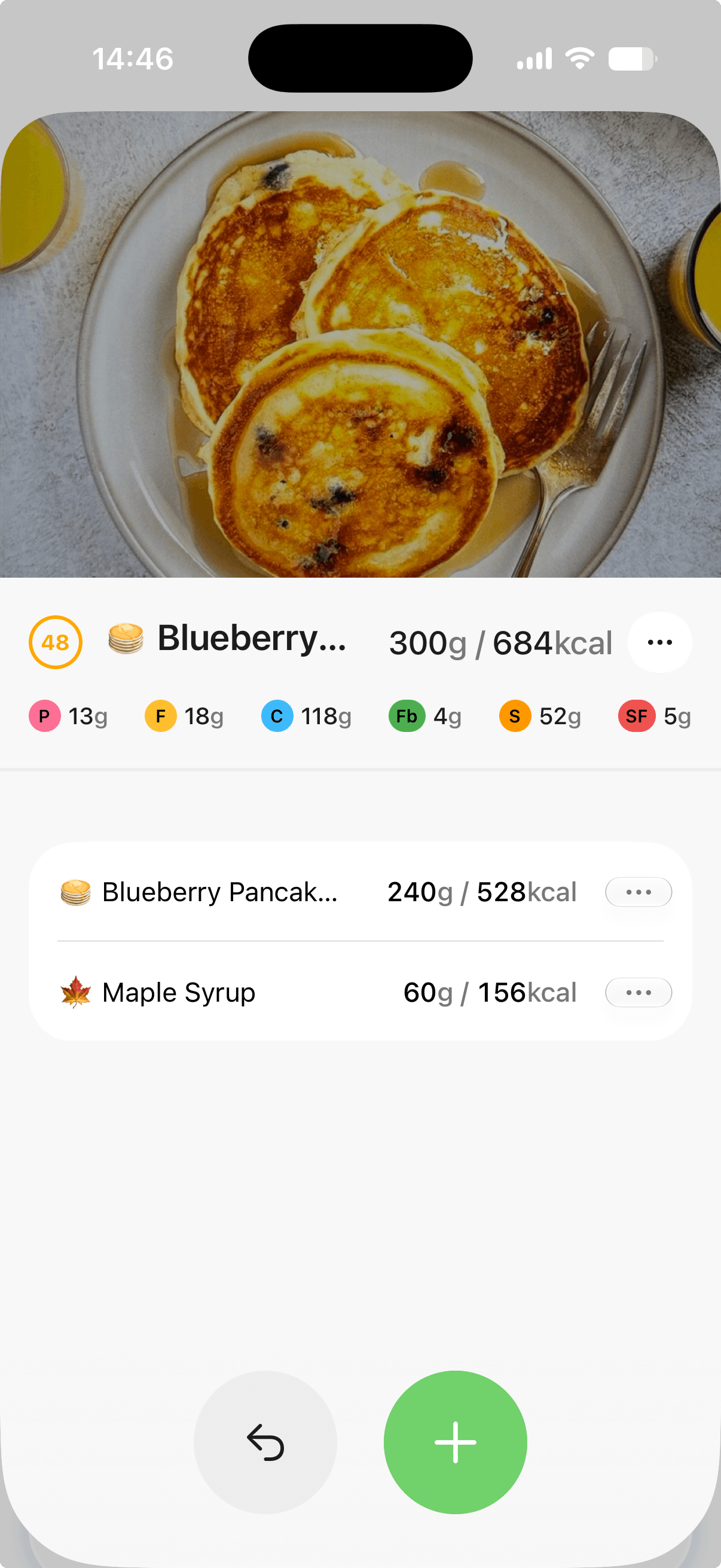
This Food Focus example lists blueberry pancakes and maple syrup separately, with estimated grams and calories for each. A photo can suggest those foods, but it cannot confirm the recipe or how much syrup was used.
Check the foods and amounts against what you actually ate, then correct the estimate before saving. The number on screen is a reviewed starting point, not a measurement from the image.
Want to use the free on-device model? The on-device AI guide explains the device requirements. Local photo analysis needs iOS 27; text and voice are available on supported iOS 26 devices.
Try the complete loop
Start with a photo. Keep control of the result.
The first 10 saved meals can use Cloud AI; after that, Cloud requires Pro. Eligible Apple devices can choose free on-device AI. Review each estimate and see whether faster, more personal logging fits your routine.
Questions about AI calorie estimates from photos
Can an app really calculate calories from a photo?
An app can estimate calories from a photo by identifying likely foods, estimating portions, and matching those assumptions to nutrition data. It cannot directly measure exact weight, hidden ingredients, or the meal’s chemical composition, so the result should be reviewed.
Can AI tell portion size from one food photo?
AI can suggest a portion, especially when the food and a useful size reference are visible. A single two-dimensional image still has limited depth information, so stacked food, bowls, mixed dishes, and unusual camera angles can make the estimate uncertain.
Are photo calorie trackers accurate?
Accuracy varies by the meal, image, food recognition, portion assumption, recipe, and nutrition record. There is no honest universal accuracy percentage for every app and every meal. Treat a photo result as an editable estimate unless a provider publishes a reproducible validation for the exact workflow being used.
Is scanning a barcode more accurate than taking a photo?
For packaged food, a correct barcode match usually gives a better product-specific starting record than a visual guess. You still need to check the product, serving size, and amount eaten because database records and labels can differ by version or region.
Do I need to weigh every meal?
No method is best for every purpose. A scale can improve portion precision when exact intake matters, while a reviewed photo estimate may be more practical for everyday awareness. Medical or highly precise nutrition decisions should use appropriate professional guidance.
Does Food Focus learn my usual portions?
Food Memory is enabled by default on each device, and its toggle is not synced account-wide. In the normal single-meal flow, it keeps one current gram hint per recognized, normalized ingredient instead of averaging. A later ambiguous photo, voice, or text analysis may use it. You can edit, delete, or clear up to 200 account entries.
Sources and further reading
These sources support the general explanation above. They do not endorse Food Focus, and research methods do not automatically establish the accuracy of any specific consumer app.
- Applying Image-Based Food-Recognition Systems on Dietary Assessment: A Systematic Review (opens in a new tab)Nutrients / PubMed Central
A systematic review describing the stages and open challenges in image-based food recognition, volume estimation, and nutrient calculation.
- Image-Based Food Classification and Volume Estimation for Dietary Assessment: A Review (opens in a new tab)IEEE Journal of Biomedical and Health Informatics / PubMed
A review of food classification and volume or weight estimation methods, their constraints, and the value of combining multiple approaches.
- Advancements in Using AI for Dietary Assessment Based on Food Images: Scoping Review (opens in a new tab)Journal of Medical Internet Research
A scoping review explaining why a single image lacks ingredient, cooking-method, and exact portion information and why additional input matters.
- USDA FoodData Central (opens in a new tab)U.S. Department of Agriculture
The USDA food and nutrient data system that Food Focus can use as a fallback for packaged-food barcode records.
- Food Serving Sizes Have a Reality Check (opens in a new tab)U.S. Food and Drug Administration
An explanation of Nutrition Facts serving sizes and why the listed serving is not automatically the amount a person consumed.
- Food Focus nutrition sources, methodology and limitations (opens in a new tab)Food Focus
The product-specific account of barcode sources, AI estimates, editable results, Food Memory, and nutrition-guidance limits.